Hot tip to Susan Page: saying “thank you” over and over to try to get a man to shut up never works. They really think you’re thanking them. Tweet by former Congresswoman Katie Hill @KatieHill4CA… Not standing down. Not being silenced
Shoutout to the @AOC who thrust the Green New Deal onto the national stage and made it the framework for debate on climate policy within two years. That’s a hell of an Overton window shift by… “just a bartender.” A Tweet by Emma Vigeland @EmmaVigeland
The Green New Deal is and has been lied about nonstop, and yet is STILL popular. It’s a massive job-creation and infrastructure plan to decarbonize & increase quality of work and life. It’s okay to call the GOP out on those lies just as we call them out on all their other lies. Alexandria Ocasio-Cortez @AOC
Misogynoir is misogyny directed towards black women where race and gender both play roles in bias. The term was coined by queerblackfeministMoya Bailey, Wikipedia.
Probably the best place to start is with The Fly. For me, the highlight of the debate was watching Kamala Harris react to The Fly landing on Mike Pence’s perfectly manicured hair. The fly landed just when Pence started on a tirade about Law & Order and I was so distracted that I missed most of what he was saying. Because Harris was making notes – probably something along the line of “Don’t lecture me on law and order, I was a Prosecutor, I was a Top Cop” – she didn’t see it land, so, when she looked over to Pence, there was The Fly, just sitting there on top of Pence’s head. Just like me, I don’t think she got it at first – I thought it was a fly in our home, on our screen – and then when she did get that it was a real fly, on HIS head, we could see the recognition crawl across her face, first her eyes and then just the faintest wisp of a smile.
This was Kamala Harris’ first time on the National Stage and she had the higher hill to climb. More realisticly, as a Black Woman, Harris started about as far down the pecking as one can get, so it is more accurate to say that she had the deeper hole to climb out of before even starting the hill climb part. She had to come across as strong but not too rude, or too loud, or too emotional, or too whatever, too something, anyway, while all Pence had to do was be his calm, white, superior, man-self. The Vice-Presidency is and always has been male, after all.
I thought Harris did just fine and, considering the hand he was dealt, I thought Pence did OK too. I know, he did continue talking over Susan Page while she was trying, ineffectively, to get him to stop, but, I’m learning the hard way, that is pretty normal for a white man. I would have been happier if Senator Harris hadn’t stressed, like three times, “We’ll let everybody keep on fracking” mostly because those unequivical statements can come back and bite you in the ass. Think George Bush the Elder saying “Read my lips, no new taxes!”. More importantly, it was unnecessary, nobody, who isn’t in the business really cares except people who are against fracking. But, actually, nobody won this debate, it was unwinnable. By now. almost all of us have chosen a side and the optimists think their side won (the pessimists probably think their side lost, of course).
The deeper problem is that the model is flawed, the model that Conflict Produces Truth. That, somehow, two sides fighting each other will reveal the otherwise hidden truth. It doesn’t, they don’t. It’s even more obvious in our Legal system. I don’t think that conflict as a sort of Universal Answer to everything – the war on terrorism or the war on cancer, even the war on poverty – is only American but we have embraced it whole heartily. I’m starting to think that the conflict model is out dated and is working to our determent. I think it is time to start thinking about what a cooperation model would look like.
Wow!!! NOW DO SOMETHING ABOUT THIS, THE BIGGEST OF ALL POLITICAL SCANDALS (IN HISTORY)!!! BIDEN, OBAMA AND CROOKED HILLARY LED THIS TREASONOUS PLOT!!! BIDEN SHOULDN’T BE ALLOWED TO RUN – GOT CAUGHT!!! Tweet by Donald J. Trump @realDonaldTrump 45th President of the United States of America
NOW THAT THE RADICAL LEFT DEMOCRATS GOT CAUGHT COLD IN THE (NON) FRIENDLY TRANSFER OF GOVERNMENT, IN FACT, THEY SPIED ON MY CAMPAIGN AND WENT FOR A COUP, WE ARE ENTITLED TO ASK THE VOTERS FOR FOUR MORE YEARS. PLEASE REMEMBER THIS WHEN YOU VOTE! ditto
Definition of roid rage in Merrium-Webster Dictionary; an outburst of anger, aggression, or violence attributed to the use of anabolic steroids
I’m feeling like I’m losing touch with reality. It started with the New York Times disclosing Donald Trump’s taxes. Everybody seemed to go bonkers over Trump only paying $750 and, to me, that seemed to be missing the point although it does read well in a soundbite. He ran as a genius businessman who would bring his business expertise to running the government but he wasn’t, isn’t, a financial genius. Donald trump’s taxes show he was losing money, his only expertise was turning a very large fortune into a much smaller one.
That disclosure was less than two weeks ago. Then the debate and President Trump – the sitting President of the United States, POTUS – seemed almost out of control, interrupting both Biden and Wallace, even yelling over them. He is the Patron Saint of the Aggrieved and, watching the debate, I could see why.
Then, what? two days later? all of that gone, like mist in the bright sun, when the White House publicly announced that the President of the United Staes has Covid19. He was rushed to Walter Reed and then? then he almost walks home. What? three days later? From almost everything the New York, or Los Angeles, Times tells me this can’t be happening. But it is…sort of. We can only guess, or read somebody else’s guess of what is really going on behind the closed doors and the obfuscation of the official news releases, the details – I’ll go so far as to say the Truth – remains elusive. My guess is that Donald Trump is sicker than we are officially being told. What doesn’t kill you, doesn’t always make you stronger, sometimes it leaves you weaker and my guess is that Donald Trump’s tremendous spirit, sheer will power, and an extraordinarily heavy steroid regime are pushing a body that is weaker than we are led to believe. But I don’t really know.
I suppose that should be the lead, we really do not know what is going on. President Trump has gone on several Tweeting storms and all the Tweets do not seem rational. He declassified the Mueller Report when he “fully authorized the total Declassification of any & all documents pertaining to the single greatest political CRIME in American History, the Russia Hoax. Likewise, the Hillary Clinton Email Scandal. No redactions!” and, I suspect, the President Donald Trump that tried to hide the report when he got impeached didn’t really want to do that. We don’t know. Donald Trump has always been impulsive and erratic and the drugs he is on can make him more so. We don’t really know. It is sort of scary.
Honestly, can you believe this shit? Sleeping Giants @slpng_giants
What if wearing a mask like all the doctors told us to, actually works? Molly Jong-Fast @MollyJongFast Editor at large @thedailybeast.
Nothing says ‘mild symptoms’ like rushed to Walter Reed. Noah Shachtman @NoahShachtman
Trump hates hospitals. He wouldn’t even go to a hospital when his older brother was dying in one. He was golfing when his younger brother died in one. This is much more serious than the WH is letting on. Mrs. Betty Bowers @BettyBowers
Is it normal to give high doses of experimental drugs to a person suffering from a very mild case of a disease? Matthew Yglesias @mattyglesias
I was talking to a friend about – what else – Trump, who, with his constant Tweeting and promoting, has become the center of the world for what? the last fourteen hundred days? About that, I guess. This time it was Trump and Covid and how he seemed to have a mild case. My first reaction was that Of course, they would say it was a mild case, they lie about everything. But the problem is that they don’t lie about everything but trying to figure out what is a lie and what isn’t, what is real and what is spin, is like trying to read tea leaves.
Or like trying to interpret what’s happening in the inner sanctum from the comings and goings of the Pope’s underlings, or a Pasha’s minions, or of the statements of any court swaddled in secrecy. At its core, the Presidency is a dictatorship, the Cabinet rarely, if ever, votes on what to do, the President decides. All presidencies have an inner sanctum and this one has an especially opaque one but it is possible to make a couple of semi-informed inferences. According to the WH press pool, originally they were told they couldn’t photo President Trump getting on Marine One for the trip to Walter Reed. According to Chris Wallace, President Trump and his entourage arrived too late to the Debate to be tested. According to Heather Cox Richardson, whose excellent daily Letters from an American was recommended by my sister Paula, Now it appears that White House officials deliberately withheld information about their condition, directly endangering other people who acted on the presumption that the Trump people weren’t infected. My inference is that the President is way sicker than we are being told and more than several high-level Republicans are also infected.
I know that powerful people often don’t want to admit they are sick, I’ve had personal experience with that once having a major investor who had a heart attack and told everybody he was on vacation. Hell, my dad did that. Still, it’s a little surprising in Trump’s case because, normally, when something traumatic happens to a national leader, their poll numbers go up. That’s what happened when President Reagan got shot and when both Boris Johnson and Jair Bolsonaro got Covid-19. But, even though he is a self-identified germaphobe, like almost everybody, President Trump must have started to believe his own bullshit. He must have started to believe Covid19 was pretty distant, pretty safe, after all, the Kung flue only became the plague after he got infected.
Nevertheless, the President has Covid19, it is probably much worse than we are being told by the White House PR staff, the Presidentail power has not formally been passed on to the VicePresident, and our country is probably leaderless right now.
Meadows [Trump’s Chief of Staff] has now changed his tone, tells Reuters: “The president is doing very well. He is up and about and asking for documents to review. The doctors are very pleased with his vital signs. I have met with him on multiple occasions today on a variety of issues”. Ryan Lizza @RyanLizza Chief Washington Correspondent @politico as reTweeted with comment Donald asking for documents to review? As often as these people lie, you’d think they’d be better at it. by Mrs. Betty Bowers @BettyBowers
In a new statement, the campaign says VP Pence “will begin a swing through key states following Wednesday’s debate in Salt Lake City, Utah. He will travel to Arizona, before voting early in Indiana and heading to other events yet to be announced.” Betsy Klein @betsy_klein
Remember: coming into this, Biden supporters said Trump is a lying ignorant bully, who supports white supremacists. He confirmed their story. Trump supporters said Biden is senile and suffering from dementia. He clearly isn’t. Everything else is peripheral. Paul Krugman @paulkrugman Nobel laureate. Op-Ed columnist, @nytopinion. Author, “The Return of Depression Economics,” “The Great Unraveling,” “Arguing With Zombies,” + more. New York City nytimes.com/column
Who was more truthful in his answers? Biden 65% (+36) Trump 29%@CNN, Among Debate Watchers #Debates2020
Radical Left Democrats are going CRAZY! Donald J. Trump @realDonaldTrump 45th President of the United States of America Washington, DC Instagram.com/realDonaldTrump
Watching the debate, my first reaction was that Trump was winning by beating up on Biden and that Biden had to just get in Trump’s face and stop the carnage by taking control, by saying something like “Shut the fuck up, let me talk when it is my turn and I’ll let you talk when it is your turn”. He had to take Trump on, he had to take command of the room. My reaction was visceral, so visceral that I got up and started pacing back and forth. I seriously considered turning off the TV.
All week I’ve wondered how Joe Biden would take on President Trump. I never wondered how Trump would take on Biden – well, not never, but not very much, although I vaguely expected him to try to rattle Biden enough to him to stutter or stumble I didn’t think of how he would try to do that – so I was rocked back by Trump’s right out of the gate full frontal attacks. Trump’s good at it, – at them – he is a natural gutter fighter, always going for the kill, and Biden isn’t; that Biden stayed coolish and almost civil, except for the few times he struck out like a cornered small dog, bothered me.
As an aside, Biden seems like he believes in government, he believes in being deferential and civil to his superiors, he believes in saluting the uniform, and it must have been excruciatingly hard for former Vice-President Biden to call the sitting President of the United States, “A clown.” End aside.
I felt dismay and anger. I felt Biden was losing. Now, thinking about the debate rather than just blindly reacting to it, and hearing and reading comments from other people , I am feeling much more sanguine. I hope and think that my first reaction was wrong. I hope my first reaction was wrong because it is those white, alpha-dog, male reactions that got us here in the first place. Like almost all of my fellow white guys, I grew up in a binary bubble thinking it was the whole world and I can still feel the undertow of my paternal, European, reactions; the pull of my ingrained European standards and beliefs. The deep down, knee-jerk, core beliefs that the alpha beta hierarchical structure, with the alpha male at the top, is somehow only natural and as it should be. This is the belief structure that has formed today’s world. This complex of beliefs have made our world a physical Eden, and they are now destroying the planet.
I think I was wrong because a big hunk of those beliefs are based on the alpha dog gets the bone so, the fact that Trump’s bullying of Biden did not work to Trump’s advantage, is hope for us all. To me it says that we, as a species, are growing past that behavior. Don’t get me wrong, we still have the ability to wipe out our species; quickly with nuclear weapons or slowly because of our addition to fossil fuels. That we have to change to survive seems self-evident but there are lots of people that admire Donald Trump and change is not going to come easily. Still, that most voters seem to be coming to the conclusion that the kind of cooperation that Biden espouses is better than the politics of anger, hate, and discord, makes me hopeful.
A 1913 Mercedes Double Phaeton – Torpedo being photographed by Malcolm Pearson.
Just before the world changed, way back in February, Malcolm Pearson and I went to see the Nethercutt Museum & Collection which is the official name of an outstanding collection of cars in Southern California. The collection has all kinds of cars with an emphasis on luxury sedans of the late 1920s into the 1930s, and oh boy! what a great time that was for cars. And yet I didn’t like The Collection or The Museum that much and I am still working out why. Because of that, I didn’t blog about it right away, and then living under Covid 19 sucked up most of my bandwidth. In spite of that, it was too good a trip and too many exceptional cars to not say something. I think that too many exceptional cars may be the crux of the problem, both The Collection and The Museum were overwhelming, I felt like the car lover equivalent of a Strasburg Goose. One stunning car after another jammed together in an order that was not discernable to me.
The Museum and the Collection are across the street from each other in the nondescript Sylmar neighborhood of Los Angeles or, as the Museum puts it, in the foothills of the San Gabriel Mountains, and are the legacy of Dorothy and J.B. Nethercutt. The Nethercutts made their fortune with Merle Norman Cosmetics which J.B. took over from his aunt, Merle Nethercutt Norman, and built into a hyper-successful cosmetic company. Dorothy and J.B. used much of the resultant fortune to buy cars and other mechanical memorabilia. Spectacular cars and – I’m sure but I have no basis to judge – spectacular memorabilia. After years of collecting, they took this extraordinary and idiosyncratic collection public in 1971.
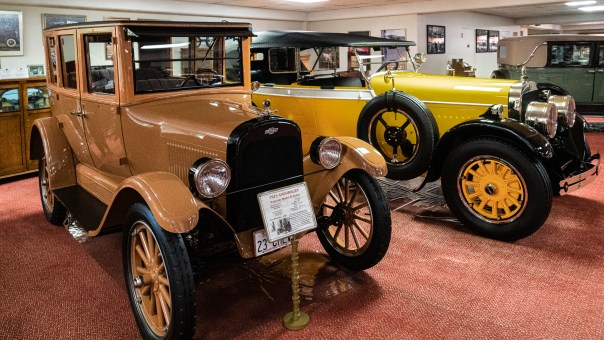
Both The Museum and The Collection are free but, to see The Collection requires a reservation on a scheduled tour for which, fortunately, Malcolm had already made reservations. We met our tour group outside The Collection Building and then walked into the building down a driveway and into a basement garage filled with an astounding group of cars, all licensed and ready to roll up the driveway and into the world. It was overwhelming, and full of fellow tourists so I had a hard time getting a photo-rhythm going. A couple of cars that caught my eye were a very early electric car and its charger which was both fascinating and completely un-understandable to me and a pre-General Motors Chevrolet.
1914 Rauch & Lang Model B4 Electric Brougham manufactured in Cleveland, Ohio with a General Electric Mercury Arc Rectifier 100 amp battery charger designed by Thomas Edison himself. 1923 Chevrolet Superior Model B Sedan, behind the Chevy – is it still a Chevy even if it wasn’t part of General Motors yet? -is a 1925 Cunningham Series V-6, built in Rochester NY. The Cunningham has a V8 engine but is the 6th of the Cunningham V series.
After the garage, the tour went upstairs to the Grand Salon, an imagined thirties through fifties showroom done in marble. The room is spectacular and architecturally, in my humble opinion, doesn’t work. We entered the showroom from sort of a backdoor and there is no sense of a Grand Entry. Bernard Maybeck designed two similar showrooms on Van Ness in San Francisco and they are all about the entry into a world of luxury. Here we sort of sneak in through the basement like we are interlopers. That aside, the cars are even better than spectacular – whatever better than spectacular is – but it is a large tour and there are people everywhere making it difficult to see the cars at our own pace and make getting a good picture almost impossible (for me, Malcolm got some excellent shots).
1934 Packard 1108 Twelve Sport Phaeton with coachwork by LeBaron Detroit and powered by a V-12 (obviously) which, to my mind is one of the nicest Packards I’ve ever seen. 1932 Maybach DS8 Zeppelin Sport Cabriolet, with a body by Hermann Spohn Karosserie in Ravensburg, has both an eight liter V-12 and, remarkably enough, an eight speed manual transmission. It was called “Zeppelin” because the same V-12s were used to power the Graf Zeppelin and, sitting in the saloon, this automobile just oozed German Teutonicness. Another picture of the 1913 Mercedes 37/95 Double Phaeton – Torpedo built by Daimler with coachwork by Henri Labourdette of Paris. Its 9.6-liter engine put out a roaring 95 horsepower. I’ve seen pictures of this automobile without a top and it is even more glamorous if that’s possible. In the flesh – so to speak – it feels very French.
Over in the corner, looking very neglected, was one of my favorite cars, the Cord 512, and I was surprised at how small and unimposing it looked. I have seen, probably, twenty of these Cord 810-812s – or two of them tens times each, I’m not sure as they do all look distinctively the same – and what a look, what a gutsy statement. The designer was Gordon Buehrig and he also designed the iconic 1956 Continental Mark II, and the car I would have taken home if I had won the door prize, a 1933 Duesenberg Model SJ Arlington Torpedo Sedan with which I took a selfie (sort of). The Duesenberg Brothers were successful racecar designers – they were the first American car to win a European Grand Prix, among other records, when they won the French Grand Prix in 1921 (the next American win was Dan Gurney’s American Eagle which won the Belgium Grand Prix in 1976) – who became unsuccessful luxury car builders. Unsuccessful meaning non-profitable in this case, the cars were terrific, very American, World-Class good, and very expensive (the Duesenberg in The Collection cost $20,000 when new which is about $397,100 now, that is a lot of money for a car without any of what we would call necessary amenities like power steering although it did have four-wheel hydraulic brakes).
1933 Cord 812 Supercharged Convertible Phaeton Sedan with a 289 cubic inch Lycoming Flathead V8 Engine producing 125bhp. It was front-wheel with a 4-Speed electric manual transmission and independent front suspension. The mighty 1933 Duesenberg Model SJ Arlington Torpedo Sedan with an admirer. Two more pictures with more car and different admirers. This 1933 Duesenberg Model SJ was built after Auburn Automobile – E. L. Cord, really – took over the failing Duesenberg company. This giant of a car has a body designed by Gordon Buehrig and built by Rollston Coachbuilders in Manhattan on a chassis designed by Fred Duesenberg with a double overhead cam, straight eight engine that put out 265 horsepower and was also designed by Fred.1930 Cord Model L29 Town Car. The Model L29 was the first production front-wheel-drive American car and this one had an 8 cylinder L-Head Lycoming engine putting out – depending on the source – either 95 or 125 horsepower. The car had about a fifteen-inch longer wheelbase than normal, no power steering, and weighed about 4,700 pounds; it could not be fun to drive but this was a car to be driven around in, to be seen in. The body was built by Murphy & Co., a well known Southern California Coachbuilder and there are numerous photographs of John Barrymore, Dolores Del Rio, and Lola Montez being driven around just to be seen. Unfortunately, this car made its debut about a month before the Crash of 1929. 1931 Hispano-Suiza J-12 Coupe de Ville with a body by Carrosserie Henri Binder of Paris. Strangely, not many cars were built in Spain and none in Switzerland, most were built in a suburb of Paris. The engine got about 220 horsepower at 3000rpm out of 9.4 liter V12 which, according to Michael Scott, was machined from a single 700 pound billet.
Parked against a back wall like a normal car is the 1928 Isotta-Fraschini Model 8A All-Weather Landaulet Cabriolet, with a body by Carrozzeria C. Castagnathat & Co., that I saw win best in show at Pebble Beach in 1976.
The 1930 Ruxton Front Drive Sedan has been one of my favorite cars since I first saw some pictures in “American Cars” by Leon Mandel although I’ve never seen an actual car. There were few made and it never made money during its short troubled life. It is one of those quirky cars that are excellent but never were able to gain traction. It is much lower than most cars of the period – 54″ to about 72″ – because the body was between the frame members rather than on them. That was possible because the Ruxton was front wheel drive which eliminated the driveshaft. To accent it’s lowness, the Ruxton didn’t have running boards and sported the best stripped paintjob I’ve ever seen (although I think I read that they only used this paintjob on a show car and that one was blue). The engine was pedestrian at best and they subbed that out to Continental Motors who is better known now for small aircraft engines.
Oh! and the headlights, I don’t want you to miss the headlights, they make the car. BTW, original headlights have become very expensive, like thousands of dollars expensive, because they are popular with high-end hotrod builders. Fortunately there are excellent reproductions available.
Above the simulated main showroom, so to speak, are two more floors of mechanical wonders, mechanical dolls and lots of hood ornaments on the third floor – as I remember – and player pianos type mechanical instruments expanded to almost orchestra size on the top floor.
Looking at the pictures of these suburb cars, the assorted paraphernalia, and the mechanical oddities, I am reminded of the old Harrah’s Museum before it became the The National Automobile Museum or the Schlumpf Brothers Museum before the French nationalized and rationalized it as Cité de l’Automobile, Musée Nationale. All three museums started out as personal collections of car nuts – is nuts too strong, would aficionado be better? – with nothing in common except their pathological passion for collecting, collecting, and more collecting. In Harrah’s case, he had about 1450 seemingly random cars including a not so random whole building that had at least one of every car Packard ever built, displayed chronologically. When Harrah died, the Holiday Inn who had bought Harrah’s casinos, got the collection and sold off most of it. The best 175 cars were used to form the backbone of a new Museum, The National Automobile Museum (while the Schlumpf Brothers had about 575 cars of which 427 were completely restored and in working order).
The Nethercutt Museum & Collection, together, is only about 250 cars, all licensed and street ready. The overall quality is much better than either Harrah’s collection or the original Schlumpf brother’s collection – overall being the operative word, here – but it still has that personal idiosyncrasy of a private collection.
Across the street from The Collection is The Museum with even more cars. This is a collection of cars and car memorabilia that is impossible to see in one trip and I’m anxious to go back.