All posts by Steve Stern

Six miles: the hard way

The good thing about the last hike, in Tuolumne Meadows, was that it was almost level. The usual Sierra hike involves a lot of elevation. To quote Ecological Subregions of California by the US Forest Service, "In west-east cross section, the Sierra is shaped like a trapdoor: the elevation gradually increases on the west slope, while the east slope forms a steep escarpment."  In other words, to get into the High Country fast, you have to start on the east side and walk up the "steep escarpment".

Once again, Richard remembered a trip from his distant past. Gibbs Lake.  In Lila, Robert Pirsig writes about how we see what we already believe. Which is why the birthers can look at Obama's Hawaiian birth certificate and see proof that he was born in Kenya, or some Republicans can read the new Healthcare Bill, see " NO FEDERAL PAYMENT FOR UNDOCUMENTED ALIENS Nothing in this subtitle shall allow Federal payments for affordability credits on behalf of individuals who are not lawfully present in the United States." and think it says "illegal aliens sign up for free healthcare here".

Anyway,as Richard remembered it, Gibbs Lake was a short hike and looking at the trailhead map seemed to confirm that. We began to entertain thoughts of going past Gibbs to Kidney Lake, a small lake, above Gibbs, in a cirque between Mount Gibbs and Mount Dana. The guide (for snowshoeing trails!) said that it was a hard hike….but that seemed to be from Hyway 395 – which was as high as anybody could be expected to get in the winter – and we were driving to the summer trailhead which cut out most of the hike. You know where this is going: It turns out that Gibbs Lake is three hard miles and 1600 feet from the trailhead.

To make matters worse, most of the trail is right up the "steep escarpment". Even the parking lot at the trailhead is steep, and then it just starts uphill with no switchbacks. I think this is the steepest trail I have ever been on with out even one switchback. After about a mile, and somewhere in the neighborhood of a 800 vertical feet, the trail became more normal, paralleling a bubbling stream.

6 walks-0746  

We continued up, up, and more up. Gradually, now, but still up and up. By now, Richard was way ahead, it was getting cloudy and colder,  and I was starting to think of a good reason to quit. My mantra became "I may be slow, but I alway get there."  Finally, everything started to level out. Most of the lakes like Gibbs are in cirques caused by glaciers so, below them, is an end or terminal moraine.  The leveling out should mean that we are getting into the cirque and the lake is getting close. After a short, sort of flat,  walk through the woods,

6 walks-0748

there was the lake. With Richard waiting. And a light rain starting.

6 walks-0752 

After a typical trail lunch of hunks of cheese and salami, we started back down. It still seemed long, but much easier.

6 walks-0755 

The Junipers were in full fruit and "smelled of unadulterated Gin".

6 walks-0756

Actually, they didn't smell at all, but I have always been taken by that line after reading it it Basin and Range by John McPhee.  As we got to the steep part, steep down now, the clouds got thicker and blocked out the view of Mono Lake. 

6 walks-0758 

It was getting colder and windier as we ended the hike, glad we were down and not camped 1600 feet higher at the lake.

But, back at home, Gibbs is the lake I would like to go back to – hummm, if we went for two nights, the three mile hike in would be fairly easy and we could hike up to Kidney Lake during the middle day. Piece of cake!
Six miles: first the easy way

A couple of weekends ago, Richard Taylor and I did two day hikes in the Sierras. They were totally different from each other and each was a typical Sierra hike.

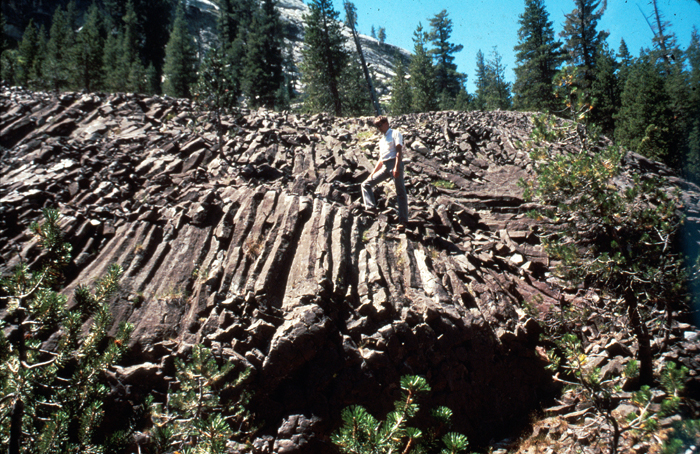
The first hike was more of an afternoon wander at 8600 feet on a soft, balmy afternoon. Really. One of those wondrous afternoons that the High Sierras serve up only a dozen days a year and only if you have been very good. The goal was the Little-Devil's Postpile, an alleged  geologic wonder that Richard had visited as a teenager on a Ranger guided trip.

We started the hike at the western end of Tuolumne Meadows on a warm afternoon with the temperature in the high 70's and,
skirting Pothole Dome on our left, followed the basin for the Tuolumne
River downstream for three miles. The first part of the trip through Tuolumne Meadows was almost flat.
6 walks-0679

At the end of Tuolumne Meadows – which, when I was about 16, I was told was the world's largest alpine meadow and I now read is only the largest sub-alpine meadow in the Sierra – the Tuolumne River drops through a resistant layer in a gentle canyon.

6 walks-0684

We followed the river through almost flat layers of rock

6 walks-0693

until got to the Little-Devil's Postpile. I wandered around looking for a good shot and didn't think about getting a record picture until later. If you are really interested, there is a picture here.

By the time we left, the shadows were getting longer and the backlighting was getting more dramatic, 

6 walks-0692

and we walked back up river passing quiet pools and lengthening shadows.  

6 walks-0696-2

My quintessential memory of the Sierra high country is walking through a high meadow on the way back to camp after a full day of walking around. The air is warm and soft and civilization is a thousand miles away. The reality is that this kind of afternoon is unusual enough that each one is memorable.

6 walks-0702-2

And this was one of those days. As we walked – wandered – back to where we started and the car, we were looking up at Unicorn Peak and Cathedral Peak. A couple of classic "horns"  that stuck up above the glaciers about a 1,000,000 years ago.

6 walks-0699

As we finished the walk, the sun was going down but it was still in the 70's. At the end, we came on a herd of deer. We counted 18 deer and all of them seemed to be bucks. I have never seen that many deer in one place, let alone that many bucks. It was a great end to a typical Sierra walk.

6 walks-0724-2

Ted Kennedy

I never really got Ted Kennedy – actually, I never really got any of the Kennedys. OK, maybe Bobby in retrospect, but not Jack or Ted. I don't think that I have ever recovered from reading The Best and the Brightest  or my dismay over Chappaquiddick. And I feel bad about that.

I believe everybody when they say he was the most influential Senator ever.  I believe everybody when they say he did more for me than most presidents. I really appreciate that he endorsed Barack Obama early – when it was a risk, when it really made a difference. He seemed to be on the right side on most issues (the definition of "right side" being the side I agree with). And I am sad that he will not be around to see Universal Health Care passed (hell – maybe none of us will be around to see UHC passed).  

A while ago, Michele and I (separately), got an heartfelt email from Obama on Kennedy (we like to think that we are on Obama's short email list of 1.75 million).

Michelle and I were heartbroken to learn this morning of the death of our dear friend, Senator Ted Kennedy.

For nearly five decades, virtually every major piece of legislation to advance the civil rights, health and economic well-being of the American people bore his name and resulted from his efforts.

His ideas and ideals are stamped on scores of laws and reflected in millions of lives — in seniors who know new dignity; in families that know new opportunity; in children who know education's promise; and in all who can pursue their dream in an America that is more equal and more just, including me.

In the United States Senate, I can think of no one who engendered greater respect or affection from members of both sides of the aisle. His seriousness of purpose was perpetually matched by humility, warmth and good cheer. He battled passionately on the Senate floor for the causes that he held dear, and yet still maintained warm friendships across party lines. And that's one reason he became not only one of the greatest senators of our time, but one of the most accomplished Americans ever to serve our democracy.

I personally valued his wise counsel in the Senate, where, regardless of the swirl of events, he always had time for a new colleague. I cherished his confidence and momentous support in my race for the Presidency. And even as he waged a valiant struggle with a mortal illness, I've benefited as President from his encouragement and wisdom.

His fight gave us the opportunity we were denied when his brothers John and Robert were taken from us: the blessing of time to say thank you and goodbye. The outpouring of love, gratitude and fond memories to which we've all borne witness is a testament to the way this singular figure in American history touched so many lives.

For America, he was a defender of a dream. For his family, he was a guardian. Our hearts and prayers go out to them today — to his wonderful wife, Vicki, his children Ted Jr., Patrick and Kara, his grandchildren and his extended family.

Today, our country mourns. We say goodbye to a friend and a true leader who challenged us all to live out our noblest values. And we give thanks for his memory, which inspires us still.

Sincerely,

President Barack Obama

The Mobil Station

I think that because I was born in California and grew up here, I am used to driving around California and the west rather than flying. It seems much more reasonable to me to just drive to LA, for example, than to fly there and then rent a car (getting around by Public Transportation or Taxi would be inconceivable). The downside is that, once one leaves the Bay Area and until one gets to the next real urban area (that would probably be Chicago – going east), there are no interesting, fast, places to eat.

Finding an interesting place to eat in the American Outback is almost impossible. The choice is between stopping at a known fast food place like Carl's Jr. or an unknown authentic local place like the Jerk Water Cafe. There are a few exceptions: Doe's Eat Place in Greenville, Mississippi, was a lucky find, or the long gone Nut Tree in Vacaville, and ….The Mobile Station on Hyway 395.

The Mobile Station is slightly uphill from where Highway 120 hits Highway 395 on the eastern side of Yosemite's Tioga Pass and it overlooks Mono Lake,

Mobile-3-0742

otherwise, it looks just like any other gas station in the boondocks,

Mobile-2-0741

Mobile-3-0744

selling – maybe – slightly better junk than most gas stations.

Mobile-4-0735

But, inside is the Whoe Nellie Deli

Mobile-5-0736

which is a very fun cafe (CafĂ© – really) serving such things as actual Espressos and Smoked Trout on a Bagel; as well as the usual bacon and eggs for breakfast. For lunch or dinner, there are – among lots of other choices – Fish Tacos, or a Chicken Caesar Salad Wrap,  or Wild Buffalo Meatloaf, or Lobster Taquitos, or St. Louis Style Ribs. And all of it is good.

It is well worth going out of your way (but probably not worth the five hour drive from Reno or San Francisco, or the seven hour drive from Los Angeles).

Meanwhile, back on the Home Front…

Steve and Michele (with Beth and Howard) went over the hill to the Eastern Sierra along Highway 395*. The plan was to drive as high as we could and spend a couple of days hiking. The first day, after taking a day hike at the top of Sonora Pass, we got to a very small lake, on the east side, at about 10,000 feet,

Eastern Sierra 0809-0561  

overlooking Bridgeport and Mono Lake.

Eastern Sierra 0809-0575

We spent the night there (some sleeping better and longer than others),

Eastern Sierra 0809-0559

and, the next day, went for a short hike above the lake,

Eastern Sierra 0809-0578

before moving on to another lake.

Eastern Sierra 0809-0640

The next day, we hiked up into the John Muir Wilderness.

Eastern Sierra 0809-0616

The first night had been windy, but, the last couple of days were perfect weather. Warm in the day and cold at night, with a glorious, still, morning the day we left.

Eastern Sierra 0809-0661   

*the Sierra Nevada Range  runs along the eastern side of California's Great Central Valley – the largest flat area in north America. The Range sloops gradually up to the east until it crests at the ridgeline. In the southern Sierra, the passes vary from 8,000 to 12,000 feet and the mountains go to 14,000. From the crestline, the Sierra drop down to Highway 395, forming the highest, steepest escarpment in the world. Starting at 395, is the fastest way to get into the highcountry.**

**above timberline.